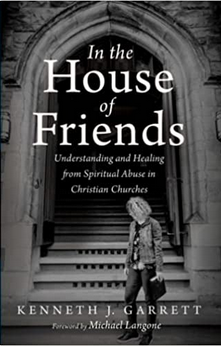
Is the church safe? If it isn’t, what would make church safe? Kenneth Garrett seeks to answer those questions in his book, In the House of Friends: Understanding and Healing from Spiritual Abuse in Christian Churches.
Garret describes through a conversation that just because a church is doctrinally orthodox in its stated beliefs, that it cannot also be a cult, or in Garret’s terminology, an abusive church. The term “cult” can and has been overused in modern society to (rightly) describe a wide variety of heretical and oppressive organizations. In his definition of a cult/abusive church, Garret writes, “[Cult] is powerful but poorly defined, and, in the minds of many, never to be suggested of a Christian church.”[1] A cult has historically been defined as an organization or a group that does not hold to an historical and biblical understanding of the person and work of Jesus Christ. Garrett pushes the definitional boundaries to include organizations and groups that sounds great from a doctrinal perspective, but inwardly devour the weak sheep in their midst. Garrett continues by describing five instances of spiritual abuse recorded in Scripture: Hophni and Phineas in 1 Samuel 3; David in 2 Samuel 11; Yahweh condemning corrupt Israelite leadership in Ezekiel 34; Jesus condemning the scribes and Pharisees in Matthew 23; and the Apostle Paul and his writings in the Pastoral Epistles to Timothy and Titus. When reading the above accounts in light of the concept of spiritual abuse (taking advantage of another individual or group under the guise of spiritual authority), one can immediately see how this problem of spiritual abuse in the Christian context is not a new phenomenon. In fact, one being taken advantage of another for their own twisted, evil ends goes as far back as the serpent’s temptation of Adam and Eve in Eden. Garrett describes “the most powerful tool of the spiritual abuser—a tool that becomes a weapon used against the members of his church: his speech.”[2] Garrett writes, “We are often fixated on the horrible things we hear of religious phonies doing…however, not every type of spiritual abuser misbehaves or indulges in the more sensual types of sin. Some lead very disciplined, outwardly moral lives while they rule over those who follow them with an iron fist.”[3] For abuse to happen, there must be a power differential between the abuser and the abused, and abuse generally comes from a pastor or someone else in spiritual authority in the church. Garrett lists out “three solid indicators of predatory pastors: their mindset, their speech, and their extraction of material, physical, and spiritual resources from those who follow them.”[4] OK, so now what? How does one heal from a traumatic spiritual experience? Garrett writes, “I believe recovery from spiritual abuse—and all of its torturous subcategories of abuse, is more an issue of choosing what to undo than it is trying to figure out what to do.”[5] Garrett offers three helpful actions to aid the healing process: “empathetic friends, kindness to self, and exploration of solid, fact-based teaching on spiritual abuse—are three powerful resources that can start the healing process within hours of your leaving the abusive church.”[6] For this reviewer, all three of those steps have been a source of grace and peace from God. It can feel a bit obsessive to always have spiritual abuse on the brain, but knowing what spiritual abuse is and giving oneself grace in a community of understanding friendship is healing. For churches that desire to be refugee camps for those leaving abusive churches, Garrett offers some advice for ministering to survivors. “Survivors of abusive churches and pastors struggle with overwhelming, gnawing feelings of isolation, loneliness, insecurity, lack of confidence, embarrassment, indecisiveness, and a host of other emotional maladies.”[7] Survivors of spiritual abuse have crises of faith, wounded souls, marriage and parenting wounds, all of which make a maelstrom of doubt and despair that can make it easy to ignore the wounded. One of the more controversial points, but in the opinion of this reviewer correct, that Garrett makes is as follows: It is critical that survivors of abusive churches be shown gracious acceptance should they choose to stop attending church services, refuse to become a member of a church, or stop identifying as Christian. (If that last point seems excessive, inappropriate, or simply unfaithful, then you may not be grasping the depth of the pain and loss that those who have been abused in the church have experienced.)[8] In all of this, God’s grace for the hurting can shine brightly through a loving, accepting church. There will likely be fallout from leaving an abusive church or pastor. It may result in loss of faith altogether, but God’s grace is greater, there is hope for the hurting. Along the same lines, Garrett writes to pastors who want to be safe, tying safety in a pastor (shepherd) with how well they emulate Jesus as the Great Shepherd. Most pastors feel they are ill equipped to respond to the needs of the survivors of abusive churches. Aside from the broad discussion of those religious groups historically deemed cults by orthodox, evangelical Christianity, seminaries do not provide extensive training in how to address the phenomenon of churches that abuse their members with a cultish fanaticism and arrogance. But just as the proper care of a physical wound is necessary for successful healing and recovery, a proper response to the wounds of the survivors of spiritual abuse have experienced is indispensable.[9] Garrett calls believers in all walks of life to care for those hurt in the name of Christ. How glorious would it be if those who claimed to follow Christ lived like they believed they were? We have prayed for revival in Western Christianity, maybe the exposure of sin and the opportunity to lament and repent from it are a gift from God. Overall, In the House of Friends is a helpful and encouraging book for both those who have endured and survived abusive spiritual organizations and those who seek to love and help those survivors. Kenneth Garrett has provided the church a helpful guide for not only escaping abusive churches but also helping those escaping. The book is highly recommended for members who suspect they are in an abusive church, pastors, church members and leaders, and friends and family of abuse survivors. [1] Kenneth J. Garrett, In the House of Friends: Understanding and Healing from Spiritual Abuse in Christian Churches, (Eugene, OR: Wipf & Stock, 2020), 4. [2] Garrett, 12. [3] Ibid., 15. [4] Ibid., 15. [5] Ibid., 57. [6] Ibid., 62. [7] Ibid., 70. [8] Ibid., 71. [9] Ibid., 81.
Affiliate disclosure: As an Amazon Associate, we may earn commissions from qualifying purchases on Amazon.com.
Healing through Ephesians, Ephesians 4:7-16
leading a host of captives in your train and receiving gifts among men” But in Ephesians, Paul writes: “When he ascended on high he led a host of captives, and he gave gifts to men.” Why the difference? Paul is getting the point across that Christ has richly provided for us all things. He is the fulfillment of the OT and is keeping His promise of never leaving us nor forsaking us.
Catchy title, I know. And apologies to Carly Simon for the riff. This blog isn’t about you. It isn’t even about me. It sure as heck isn’t about a geriatric con artist in Illinois. This blog isn't about you. “What is this blog about?”, you ask. It’s about standing for the truth of the Gospel in the face of a perversion of the Gospel. It’s about holding out hope and healing to the many, many victims of Gothard’s lies that have seeped everywhere. Gothardism is no gospel. It’s not good news. It’s rather bad news. Just like the real Old Testament law, there is no way for you or me to perfectly obey it. But, unlike the real OT law, Gothardism doesn’t point to Jesus as its fulfillment, but only your obedience or lack thereof. Romans 7:7-25 has a lot to say about the relationship between the law and righteousness. Gothardism must have its own law because it has its own gospel. If you just follow these steps, attend this seminar, use this curriculum, then all the things you want, all you desire will be yours! It’s the same, tired, prosperity gospel, but instead of lots of money, a nice car, and a nice house in suburbia, your spouse will listen to you, your kids will obey, and you’ll have “success” (whatever that means). Con artists use fear or greed to get you to do what they want. Gothard capitalizes on both. Fear of your kids’ lives going off the rails; greed because your god is the American Dream.
Jesus only promised us a couple of things: that He wouldn’t leave us, and that we would suffer here on earth. But I’ll take Jesus over that any day. In conclusion, why does this blog exist? To expose wolves and exalt Christ. Misquotations There are multiple anecdotal or unsupported quotations. A Google search on “We take the Bible away from children when they enter school and give it back to them when they enter prison” (Institute in Basic Life Principles, 1999, p. 3) yielded no conclusive results on its origin. Also, “morally flat” (Ibid., p.3) and “realm of the amoral” (Ibid., p.3) are in quotations but no citation is given for them. It would be easy to dismiss such slovenly writing and editing as the best that a not-for-profit organization can do. But, if a college freshman can be expected to cite sources in a specific manner, and be penalized for not citing sources correctly, surely an organization with multiple millions of dollars in real estate holdings can figure it out. By far, my favorite example of deception used to construct this false teaching in this document is that IBLP misconstrues Charles Ryrie’s argument in his essay, “The End of the Law” found in Vital New Testament Issues edited by Zuck (1996). 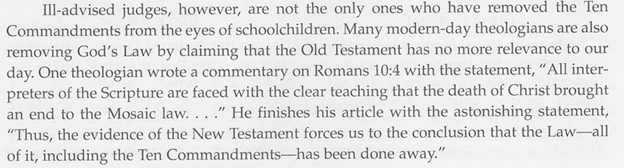 If a college freshman can be expected to cite sources in a specific manner, and be penalized for not citing sources correctly, surely an organization with multiple millions of dollars in real estate holdings can figure it out. The issue with Gothard’s use of this edited quotation is that first, he didn’t quote the entire passage. The entire passage reads as follows with the edited portion highlighted: “All interpreters of Scripture are faced with the clear teaching that the death of Christ brought an end to the Mosaic Law (Romans 10:4) while at the same time recognizing that some of the commandments of that Law are restated clearly and without change in the New Testament epistles.” (Zuck, 1996, p. 79) Rather than making a blanket statement that the law is completely over and done with as Gothard would want us to believe that Ryrie writes, Ryrie is describing the conundrum that Bible interpreters run into. That conundrum is that the Christ has brought an end to the law in one sense, but there are also standards for Christian living given in the New Testament that sound a lot like the law. Contrary to IBLP’s claim, the other quotation from Ryrie’s essay is not at the end of the essay, but a setup for the tension of the law being completed and done away with in Christ but the New Testament also having moral commands. 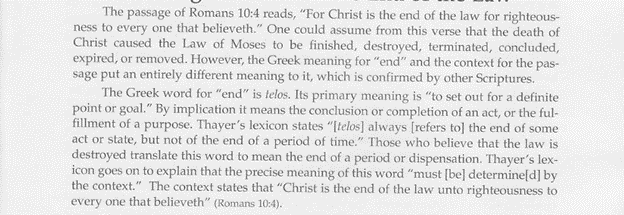 We’ve already explored in Part 1 on this section of the document on the use of Scripture. IBLP quotes Thayer’s Lexicon as a proof that the Greek word telos does not have a time category associated with it. However, they fail to accurately quote Thayer’s entire entry in the Lexicon, and seemingly, create an entirely new definition of telos not even based on Thayer’s. IBLP’s definition of telos is, “to set out for a definite point or goal.” Thayer’s definition is as follows:
But the most disturbing thing about IBLP misquoting Thayer’s is their willingness to create an entire doctrine of the unchanging nature of the application of the Old Testament law around half a lexical entry. The entire sentence reads thus: 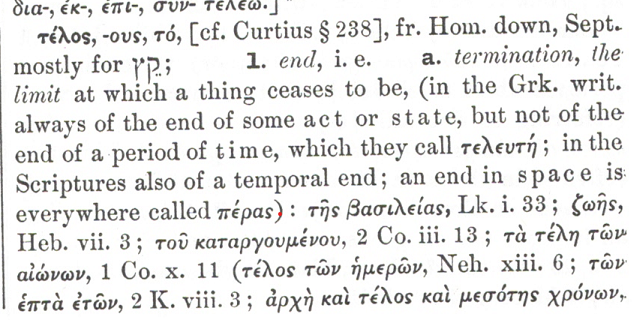 IBLP insists on a definition from a lexicon and then proceeds to create its own definition not found in that same lexicon. There are plenty of passages in Scripture where telos has a temporal (time) aspect to it. Something that was, came to an end, and therefore it ceased to exist in the same way as before. Logical Fallacy Gothard is claiming not just the moral law, but also the civil and ceremonial law should be in force. From about the 13th century to the present, there has generally been an understanding within theology that the civil and ceremonial portions of the law are either fulfilled in Christ or will be implemented perfectly in the millennium as part of the consummation. I don’t personally hold the moral, civil, and ceremonial division of the law. I believe that something deeper is going on with Christ fulfilling the law on our behalf and if we’re in him, we have already fulfilled the righteous requirement of the law. Charles Ryrie argues ably that the law is and always has been a unit and was done away with in Christ, but that we in the church today have a higher calling upon our lives, that is, to love God and love our neighbor. What Gothard butchers in his inadequate quotation of Ryrie goes a long way to show how deceitful Gothard is and how Ryrie has the correct perspective on the law as it applies to the New Testament believer. Charles Ryrie argues ably that the law is and always has been a unit and was done away with in Christ, but that we in the church today have a higher calling upon our lives, that is, to love God and love our neighbor. This is a logical non sequitur (it does not follow). It’s one thing to argue that the civil and ceremonial laws are done away with in Christ, but the moral still applies today. There are plenty of orthodox, evangelical theologians who hold to that position. What’s outside the bounds of orthodoxy is insisting on a three-fold division of the law while also insisting that the civil and ceremonial portions still apply. To that, I would reply: “I see that you insist on the ceremonial laws of say, after childbirth since they’re ‘confirmed’ by medical science—what ‘science’ that is doesn’t matter enough to cite it apparently—but there’s also a bunch of animal killing that you’re not insisting on that’s tied to those same laws. Who are you, then, to relax that part of the law while insisting that the other part still applies? Also, I notice that you cut the corners of your beard and don’t wear tassels on your cheap navy suits.” Seems like there’s a lot of law Gothard likes to ignore, but whenever he has “insights” like he’s another Messiah, that’s what applies to all Christians today in his mind. Conclusion If I view the law, the Bible, etc., as ultimately about me, then I’ve replaced the God of the Bible with a god of my own creation. And he looks a lot like me. Misusing God’s word for my own personal “success” as Gothard and Co. are fond of preaching, will only end very badly on judgment day. This is a false gospel (if you just obey, you will get what you want!) with a false canon (Basic and Advanced Seminars, Advanced Training Institute, Wisdom Booklets, counseling training) all lead by a false messiah (Gothard himself). There’s only one person who is above reproach in the IBLP universe, and it's Gothard. Ironically, whatever hit the fan in 2014 that led to Gothard being fired by his own board of yes-men, IBLP is still peddling Gothard’s wares and teaching what he taught. Gothardism is a different religion, as opposed to the Christianity it mimics and mocks at the same time. I already have a Messiah; his name is Jesus. Hebrews 8:6-7 But as it is, Christ has obtained a ministry that is as much more excellent than the old as the covenant he mediates is better, since it is enacted on better promises. For if that first covenant had been faultless, there would have been no occasion to look for a second. (ESV) May God see and judge. Bibliography Institute in Basic Life Principles. (1999). Discerning God’s Will in Every Decision. Institute in Basic Life Principles Oak Brook, IL. Thayer, J. (1995). Thayer’s Greek-English Lexicon of the New Testament: Coded with Strong’s Concordance Numbers (Reissue,Subsequent ed.). Hendrickson Academic. Zuck, R. B. (1996a). Vital New Testament Issues (Vital Issues Series, Vol 8). Kregel Academic & Professional. Scripture quotations marked (ESV) are from The Holy Bible, English Standard Version(R) (ESV(R)), copyright (C) 2001 by Crossway Bibles, a publishing ministry of Good News Publishers. Used by permission. All rights reserved. The Wolf: Bill Gothard and The Institute in Basic Life Principles The Institute in Basic Life Principles (IBLP) is an organization that grew around the ministry of Bill Gothard, who in the early 1960’s began speaking to large conferences on how to apply the Bible to everyday life, mostly by upgrading the Old Testament law for today. The teachings and programs that grew out of that initial organization, Advanced Training Institute (ATI) for homeschooling, youth conflict resolution, family support has largely been based on poorly exegeted Scripture, a misunderstanding of the Bible as a whole, and a reliance on at least works-based sanctification, if not works-based salvation. I’m seeking to expose these lies as the heresy that they are. Wolves often quote Scripture and sound correct on the outside. In fact, Satan himself quotes Scripture to Jesus as part of his temptation of Christ, and Christ refuted his misapplication of Scripture with Scripture. “Discerning God’s Will in Every Decision” is a document published by IBLP as an introduction to the 52 Wisdom Booklets that made up the core of IBLP’s homeschool program, ATI. The Lie? - Scripture Twisting How we quote Scripture reflects what we believe about God and the Gospel; how we quote and use other authors’ writings reflects how we view our neighbor. Since God is a God of order, we can use logic to make arguments for or against a position of biblical exegesis. If Scripture is God’s Word, we must treat it with the respect that the Word of God deserves. We are applying three standards when reviewing this document: Does the author of this document accurately use Scripture? Does the author of this document accurately quote and cite exterior references? Does the argument logically flow? I contend that the Institute of Basic Life Principles in authoring this document fails to satisfactorily accomplish all three of these standards. Does this document accurately use Scripture? Does the misuse of Scripture reveal a pattern of dishonesty that should invite rebuke from the larger church? Trust, once broken, is difficult to mend. An unrepentant usage of Scripture that enables falsehood and wrong doctrine to flourish should be rebuked by the larger church. Romans 10:4. IBLP refers to Romans 10:4 in two places, pages 3 and 15. Trust, once broken, is difficult to mend. An unrepentant usage of Scripture that enables falsehood and wrong doctrine to flourish should be rebuked by the larger church. 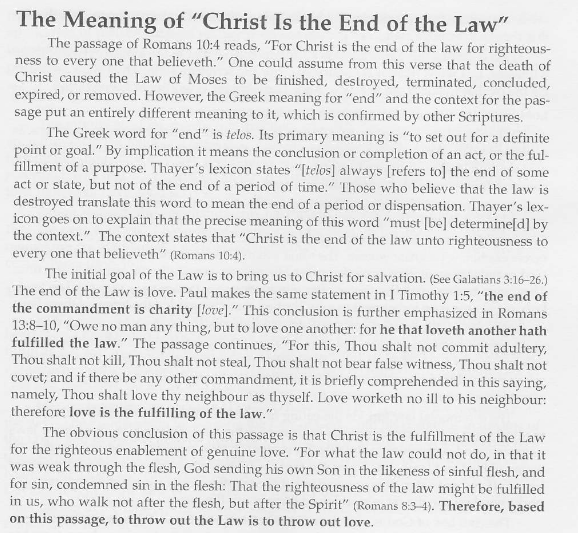 Contrary to what the author of the document asserts, telos DOES have a temporal aspect to it in the NT. The quote from Thayer’s Lexicon (which I will also examine later in this essay) refers to the use of telos in extrabiblical Greek, not its use in the New Testament. Thayer goes on to point out that in the New Testament telos can and does refer to an end as a point in time, not merely purpose. To that end, since telos can mean end as in “no longer effective”, that usage better fits the context of Romans 10. Paul is arguing that although physical Israelites zealous for the law, they desire righteousness, but being ignorant of the point or the purpose of the law seek righteousness in their own rules. Ironically, Romans 10:4 could be applied to a hard-core follower of Gothard’s teachings. Being ignorant of the purpose, point, or that the law even has come to an end, they have created their own “law” that enslaves, holds forth false hope, and ultimately creates unbiblical guilt and shame in the lives of their adherents. Ignoring the context and what Paul was driving at with “The one who does them shall live by them.” (Galatians 3:12). Paul is arguing in Galatians that the Old Testament law has no authority over New Testament believers. IBLP on page 21-22 tries to make the argument that “the one who does them shall live by them” applies to New Testament believers, rather than what the ACTUAL context of the verse is, that all are under the curse of the law. The curse being that the law can only condemn, it cannot save. Salvation was never the purpose of the law (Hebrews 8:13). IBLP continues in giving examples from the Old Testament on Israel’s failure to keep the law as examples of why New Testament believers must keep the law. That’s a glaring bait-and-switch. IBLP claims that following or obeying the law is the “discovery and enjoyment of true life” (Institute in Basic Life Principles, 1999, p. 22), which is a complete contradiction of John 17:3 in that eternal life (real, true life) is found in knowing God through Christ. If you’re in Christ, you’re already there. You don’t need a broken-down charlatan like Gothard to give you more rules. 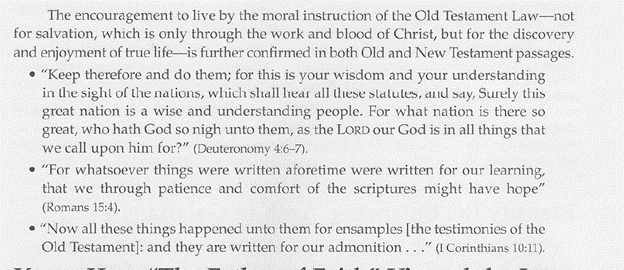 I John 5:2-8. Ignoring the context and skipping over verse 5! Not to mention including the spurious reading of verse 8. At the risk of becoming technical, I will raise the tackle the quotation of I John 5:2-8. There’s an interesting ellipsis in IBLP’s quotation of the passage. The full passage reads as follows with the edited portion highlighted in red, along with the broader context of I John 5:1-12 in the ESV.
A lot of false teaching is not in what false teachers are saying, but what they are not saying. I could get off in the weeds about how most of verse 8 is spurious and not part of the original Greek text. For more information, the NET Bible has a helpful article here. There also is the soul, spirit, and heart division of the human soul that rather than clear divisions in the Bible, seem more like synonyms for the same thing. What is clearly argued in this section is that if we just discern God’s will (God’s will most clearly seen in the Old Testament law), and if we just obey all these rules, then we’ll have “success” (whatever that means). What the passage says, in my paraphrase: If you are in Christ (and John is writing to believers), then you’re already born of God (v.1). How do we know we’re children of God? Because we love and obey God in a New Testament context (v. 2). What is the love of God? Obeying him (v. 3). How do we overcome the world? By being born again (John 3). And what does overcoming the world look like? Our faith in Christ (v.4). And who has overcome the world? The one who has faith in Christ (v.5). Christ overcame the world, and if we’re in him, we overcome it too. Who is Jesus Christ? He came by water and blood. He was physically incarnate. He poured out his blood as a satisfaction for God’s wrath on the cross (v. 6). How do we know this? The Spirit testifies. Jesus is who he said he is, and God the Holy Spirit testifies that truth also (vv.7-8). Testimony of humankind is one thing; the testimony of God is much greater (v. 9). How do we hear this testimony? By believing in the Son of God (v. 10). Disbelieving the Son by implication is disbelieving God himself. We call God a liar if we do not believe him. What is this testimony? That we have eternal life, and that that life is found in Jesus (v. 11). Who has this life? Whoever has the Son (i.e. faith in Christ) (v. 12). What my thoughts are on why IBLP would skip v.5 as well as start the quotation at v. 3 and end at v. 8 is that they are trying to skip over the parts that make knowing Christ the central part of the passage. They seem to want to jump over anything about faith and that that faith in Christ is the foundation for everything in the Christian life. In my next post, I will detail the next set of deception in "Discerning God's Will in Every Decision" as it relates to IBLP's quotations of other authors. Bibliography Institute in Basic Life Principles. (1999). Discerning God’s Will in Every Decision. Institute in Basic Life Principles Oak Brook, IL.
Thayer, J. (1995). Thayer’s Greek-English Lexicon of the New Testament: Coded with Strong’s Concordance Numbers (Reissue,Subsequent ed.). Hendrickson Academic. Gingrich, W. F., & Danker, F. W. (1983). Shorter Lexicon of the Greek New Testament (Second ed.). University Of Chicago Press. Zuck, R. B. (1996). Vital New Testament Issues (Vital Issues Series, Vol 8). Kregel Academic & Professional. Scripture quotations marked (ESV) are from The Holy Bible, English Standard Version(R) (ESV(R)), copyright (C) 2001 by Crossway Bibles, a publishing ministry of Good News Publishers. Used by permission. All rights reserved. The Boar in the Vineyard - Mission Statement "Arise, O Lord, and judge thy cause. A wild boar has invaded thy vineyard."1 So Pope Leo X wrote at the beginning of Exsurge Domine, the papal bull that condemned Martin Luther and his teachings on justification by faith alone. Ironically, the true boar in the vineyard was not Luther, who was calling the Roman Church to repentance, but a corrupt structure where those in power misinterpreted God’s Word for their own aggrandizement. Luther was calling the church back to an understanding of justification by grace alone, through faith alone, through the person and work of Christ alone, based on the Word of God alone, for the glory of God alone.
Today, wolves in sheep’s clothing still have need to be exposed for all to see their error and for the church to be resilient against their false teaching. Our concern is not just for people harmed and exploited by false teachers directly, although that is important. Our concern is for the next generation or two who find these teachings as part of the Christian urban-legend ecosystem, and don’t know where they came from, but nonetheless the teachings are still false and abusive. The first and only drum we’re going to beat is the truth of God’s Word and the application of the Gospel to everyday life. We will expose outright falsehoods, half-truths, slovenly exposited Scripture, poor citations. And that is just the first document we’ve analyzed. The first ministry or organization’s teaching we will explore is Bill Gothard and the Institute in Basic Life Principles (IBLP). There currently exist several quality websites devoted to exposing and explaining false teaching that originated in IBLP like Recovering Grace We will add to the corpus of knowledge that many others have bravely done before. This project is not easy. I personally have already faced down a lot of self-doubt and emotional triggers tied to these teachings. I hope this website is helpful to anyone trapped in either this or another spiritually abusive system. I hope this website is helpful to anyone whose loved ones are trapped in spiritually abusive systems. I hope that God is glorified in the rescue of the weak and powerless from the jaws of spiritual wolves. If you are trapped, there is help. You are not alone. 1 Cited in Bainton, R. H. (2013). Here I stand : a life of Martin Luther (pp. 137–138). Nashville Abingdon Press. |
Andrew
Trouble-making Zealot Archives
September 2024
Categories
All
|
 RSS Feed
Site powered by Weebly. Managed by Hostgator